NVIDIA Debuts Vera Rubin Platform and Rubin HPC GPU
NVIDIA introduces the Vera Rubin platform and Rubin HPC GPU, delivering generational performance gains in MLPerf benchmarks and scientific computing.
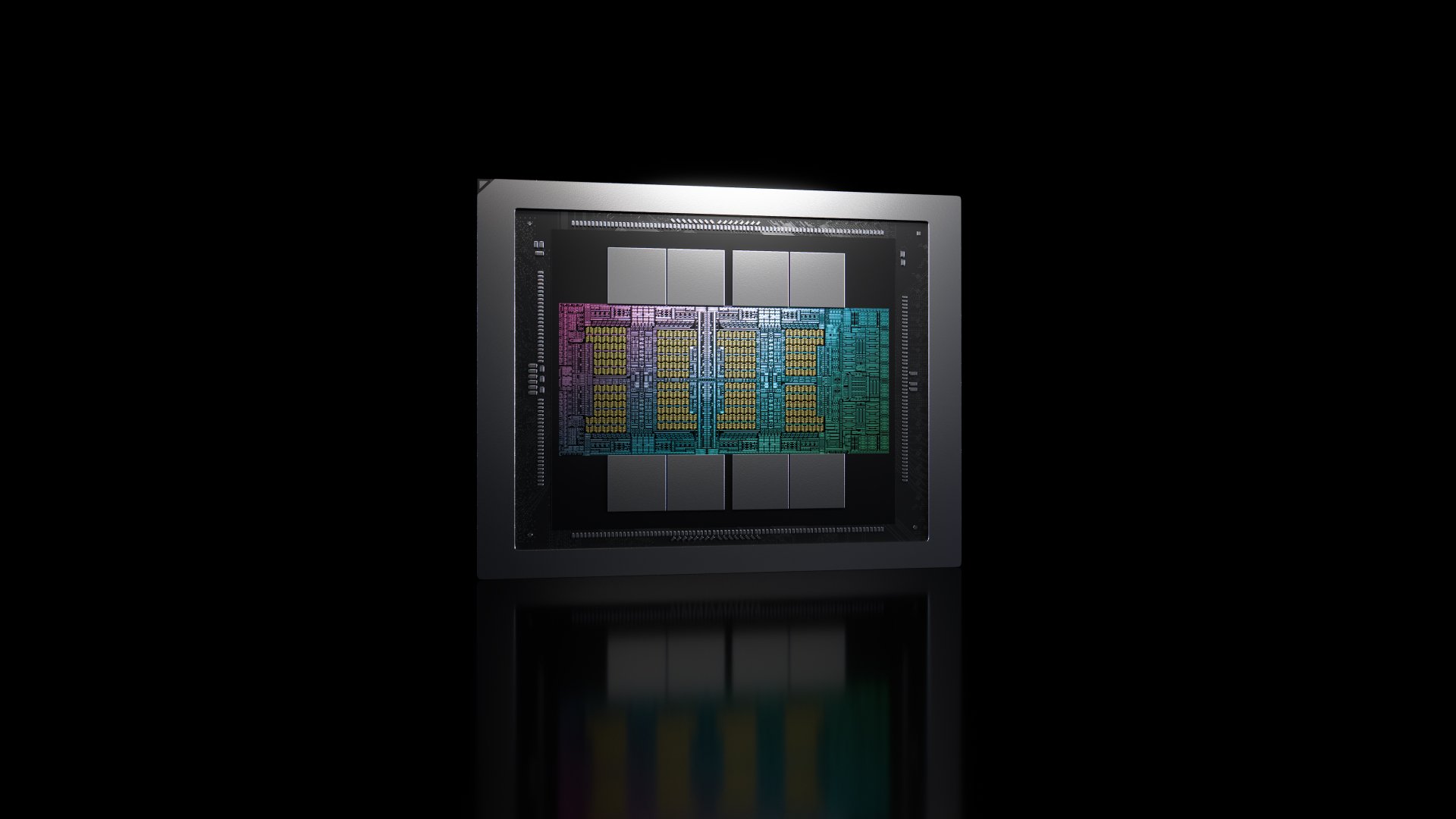
NVIDIA announced the Vera Rubin platform and the Rubin HPC GPU, showcasing benchmark results across MLPerf Training v6.1 and MLPerf Endpoints. The hardware targets training, post-training, agentic inference, and scientific simulations.
What changed
NVIDIA introduced the Vera Rubin platform, which debuted in MLPerf Training v6.1 and MLPerf Endpoints benchmarks. According to NVIDIA, the Vera Rubin NVL72 system delivered up to 2x more performance per GPU than the NVIDIA GB300 NVL72 system. On the DeepSeek-V3 benchmark, Vera Rubin NVL72 scaled from 256 to 1,024 GPUs with approximately 97% efficiency, reducing training time from 16 minutes to about 4 minutes.
In MLPerf Endpoints, NVIDIA reported that Vera Rubin NVL72 systems delivered more than 10x the throughput per watt of NVIDIA GB300 NVL72 at the same response speed in a provisional result for the Kimi K3 model. The provisional Vera Rubin K3 result (result 1.0.1.kimi-k3.agentic_combined.1p, run 9) recorded a concurrency of 1,024 queries, TTFT P90 of 4,673.9 ms, system throughput of 41,414.2 tokens/sec, E2E average interactivity of 50.4 tokens/sec per user, and an operating power of 100.89 kW using 32 accelerators. The comparative NVIDIA GB300 NVL72 result (1.0.0.kimi-k3.agentic_combined.1, run 6) used 48 accelerators, concurrency of 48 queries, TTFT P90 of 2,305.1 ms, system throughput of 2,210.4 tokens/sec, E2E average interactivity of 56.2 tokens/sec per user, and an operating power of 60 kW.
Additionally, NVIDIA announced the Rubin HPC GPU within the Vera Rubin platform, scheduled for availability in 2028. Designed for science, engineering, and analytics workflows, the Rubin HPC GPU features:
- More than 50,000 CUDA cores on a single GPU.
- Sparse data acceleration capability to supply data to the cores.
- Seventh-generation NVIDIA NVLink interconnect technology for GPU-to-GPU connectivity.
- Balanced data movement and compute scaling for recurring simulation patterns like sparse matrix operations, stencil computations, sorting, and reductions.
What it means in practice
Teams running autonomous scientific agents and intensive simulations can utilize Rubin HPC to shorten the loop of hypothesis, simulation, and refinement. NVIDIA notes that the architecture pairs with NVIDIA CUDA-X libraries to supply optimized implementations of complex algorithms. For data center operators and AI infrastructure planners, the platform's throughput-per-watt metrics in agentic inference address power limitations in AI data centers where token generation volume dictates capacity. However, NVIDIA notes that the Vera Rubin MLPerf Endpoints results are provisional, pending MLCommons Association verification and peer review, and are subject to change.
Context
This release builds on NVIDIA's established pattern of scaling high-performance computing and AI infrastructure architectures, moving from previous generations such as the GB200 and GB300 systems toward higher density configurations like the NVL72. The introduction of Rubin HPC extends these generational improvements into specialized scientific computing and agent-driven simulation workflows.
Evaluating the Vera Rubin platform involves assessing whether the reported throughput-per-watt gains for agentic workloads and the simulation speedups justify procurement cycles, keeping in mind the 2028 deployment timeline for Rubin HPC.
Sources
This article was written from the following, all of which are worth reading in full:
- nvidia
- gpu
- hpc
- ai