NVIDIA Launches RTX Spark Compact Desktops and DGX Spark Developer Kit
NVIDIA introduces RTX Spark compact desktops and the DGX Spark HPC Developer Kit, bringing local AI, agents, and multi-node compute to the desk.
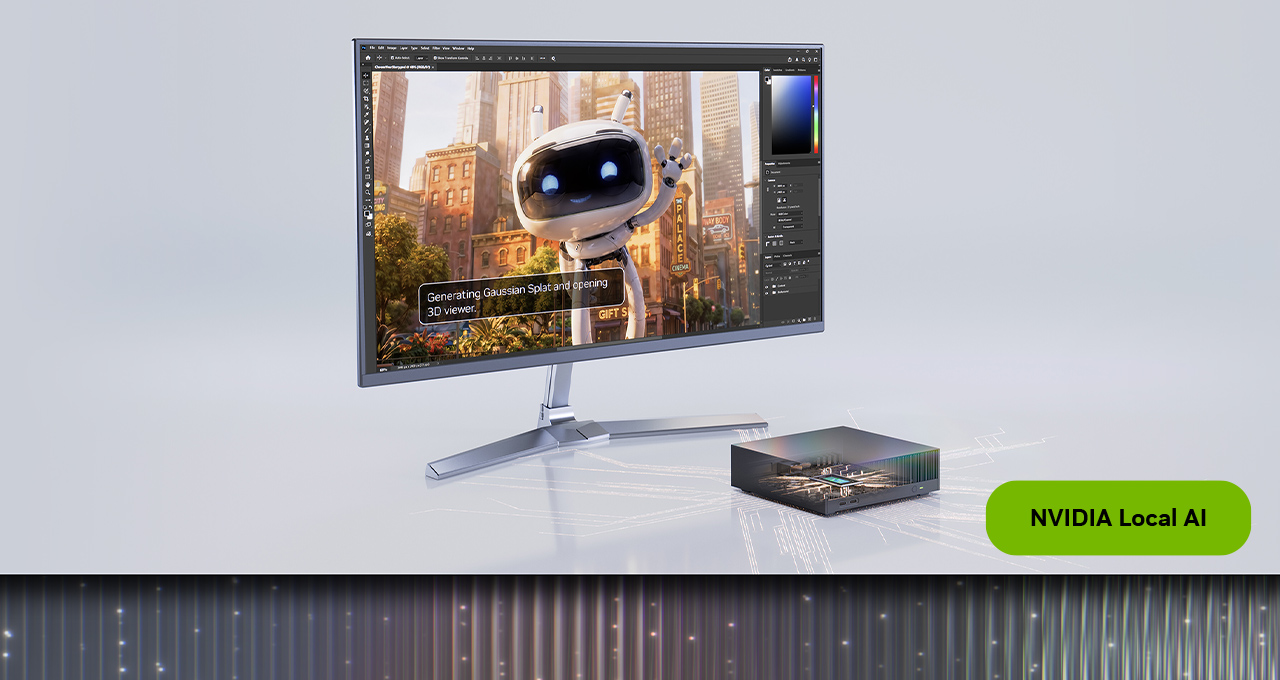
NVIDIA released new RTX Spark compact desktops alongside the DGX Spark HPC Developer Kit, expanding local AI and high-performance computing hardware options for desktops. ASUS, Dell, and MSI are shipping the compact desktops, which feature up to 128 GB of unified memory, a 20-core NVIDIA Grace CPU, and an NVIDIA Blackwell RTX GPU with 6,144 CUDA cores. Simultaneously, NVIDIA introduced the DGX Spark HPC Developer Kit, a four-node cluster linked directly in a ring topology over NVIDIA ConnectX-7 networking without requiring a network switch.
What changed
- RTX Spark Compact Desktops: ASUS, Dell, and MSI launched systems equipped with up to 128 GB of unified memory, a 20-core NVIDIA Grace CPU, and a Blackwell RTX GPU delivering up to 1 petaflop of AI performance. Ten-gigabit Ethernet connectivity enables fast data transfers.
- DGX Spark HPC Developer Kit: Announced at SC26, this four-node cluster links systems directly in a ring topology using NVIDIA ConnectX-7 networking. It provides 512 GB of combined memory, 16 TB of NVMe storage, and runs on the GB10 Grace Blackwell Superchip.
- Software and Ecosystem Updates: Adobe updated Premiere, Photoshop, Substance 3D Painter, Illustrator, and InDesign with native Windows on Arm support and TensorRT-RTX acceleration. Blender 5.3 added DLSS 4.5 Ray Reconstruction to the Cycles viewport. Windows ML now supports running any GGUF model from Hugging Face via the
llama.cppbackend, alongside an experimentalDxCGCbackend for game developers using DirectX 12.
What it means in practice
The hardware additions allow developers, researchers, and creators to run massive 120-billion-parameter large language models or deploy models up to 700 billion parameters locally using NVFP4 across the four-node DGX Spark cluster. This local execution avoids per-token cloud API charges and eliminates cluster queue times, which the Rubin Lab at IGI at UC Berkeley reported resulted in results arriving 15x sooner. The DGX Spark Developer Kit lets teams develop and debug multi-node scientific applications using the NVIDIA HPC SDK before scaling to larger data center systems. Networked storage integration and 10-gigabit Ethernet on the compact desktops facilitate handling large datasets and asset transfers. However, teams must acquire the hardware from OEM partners such as Acer, ASUS, Dell Technologies, GIGABYTE, H3C, HP, Lenovo, MSI, and xFusion.
Context
These releases follow NVIDIA's expanding hardware and software push for edge and local processing, building on earlier 2026 models like the RTX Spark Windows laptops. The introduction of compact desktops and the multi-node DGX Spark kit extends the hardware line from mobile devices to stationary workstations and desk-based supercomputing clusters, integrating previous software advancements in local AI agents, model fine-tuning via Unsloth, and specialized developer tools.
NVIDIA's latest releases offer a viable path for running intensive AI and scientific simulations locally. Organizations with fixed compute allocations can utilize these systems to streamline development workflows before committing to larger production runs.
Sources
This article was written from the following, all of which are worth reading in full:
- NVIDIA RTX Spark Compact Desktops Out Now — blogs.nvidia.com
- NVIDIA DGX Spark Developer Kit Turns a Desk Into a Supercomputing Lab — blogs.nvidia.com
- nvidia
- ai
- hardware
- hpc